Small Business Standard — The standard a business is measured against when it's built, bought, or sold.
How it works

The same problems keep coming back.That’s not bad luck.

Nothing you tried was wrong — just incomplete. Every framework was built to fix one part of a business. None was built to define the whole thing.

Book a free Standard Session Free · 90 minutes · Not ready to talk? Take the free Score first — 15 minutes, no account.
The architecture

Four. Eleven. Twelve.
That’s the whole thing.

4

Root causes

Nothing written down. No money floor. Selling depends on you. No repeatable way. The diagnosis — what explains the pattern.

11

Domains

Where the four actually show up in a business. The levers — because domains are what you can work on.

12

Essential Elements

What closes them. Each one installs a defined mechanism and passes on evidence.

The Standard — the book that lays out the whole architecture, cause by cause — releases in 2026.

One domain works differently
Domain 06 is the founder.

Founder dependency isn’t a fifth root cause — it’s what the other four add up to. But it’s the one domain where the instrument has to point at a person rather than a process, because a founder can’t reduce the business’s dependence on him while his own operating system is the thing holding it up.

That layer has its own standard. The Personal Operating Standard™ is our sister standard — same discipline, same insistence on a defined bar, applied to how a person runs their week instead of how a business runs its quarter. Inside an engagement it’s the instrument beneath Domain 06. See the Personal Operating Standard →
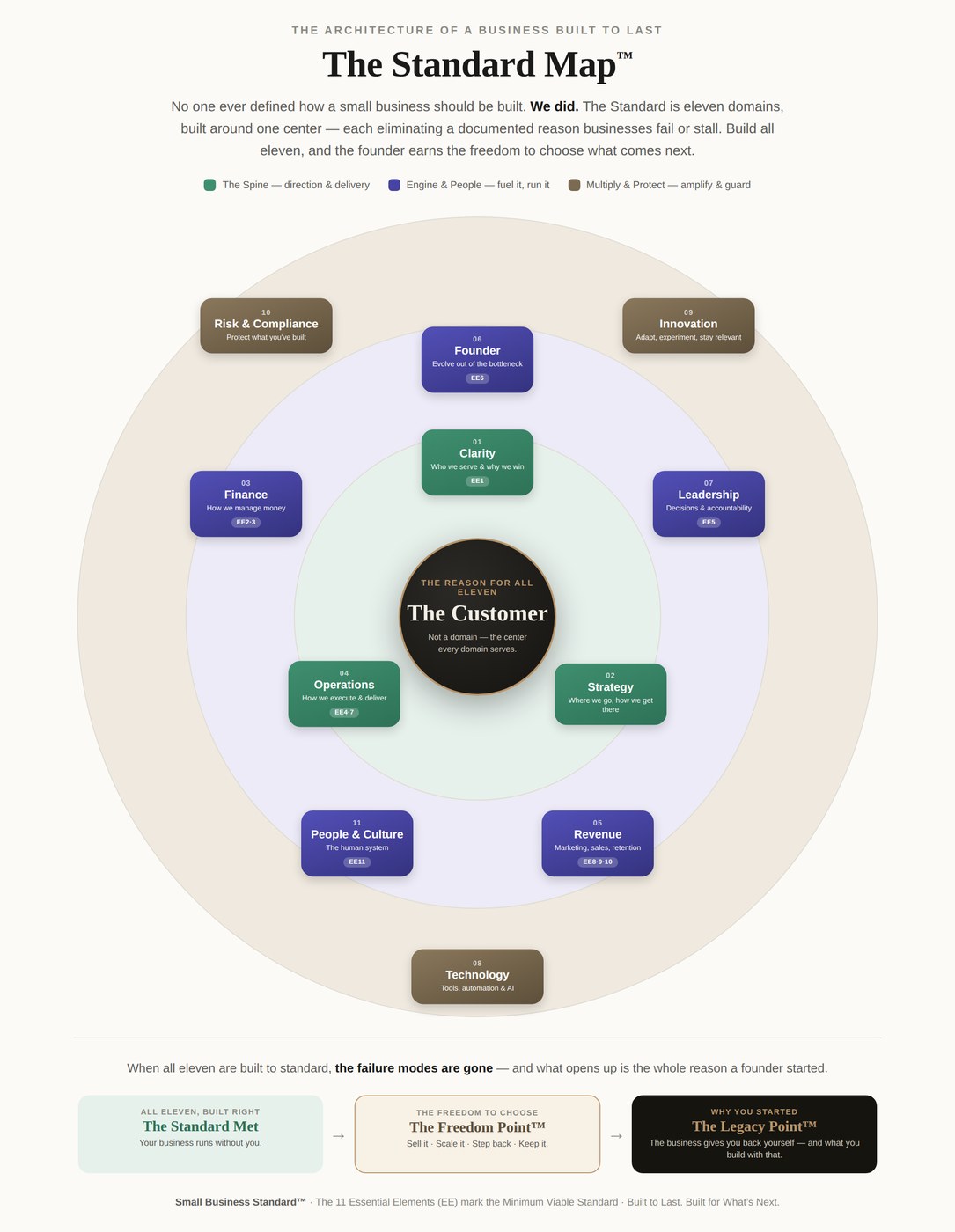
The Standard Map — the Customer at the center, surrounded by eleven domains in three layers: the Spine (Clarity, Strategy, Operations), Engine & People (Finance, Revenue, Founder, Leadership, People & Culture), and Multiply & Protect (Technology, Innovation, Risk & Compliance), leading to the Freedom Point and the Legacy Point.
The Standard Map™ — eleven domains built around one center. The Customer isn’t a domain; it’s the reason for all eleven. — and past the Freedom Point, the Legacy Road →
What makes it a standard

Every element passes on evidence.
Never on effort.

A goal is something you work toward. A gate is something you pass or you don’t. Each Essential Element has a defined installation, a required result, and a gate that checks whether the result actually exists — not whether the work felt hard.

The binary principle
Either the business meets it, or it doesn’t.

There is no eighty percent. There is no “we’re working on that one.” The gate is the same for a two-person shop and a forty-person company — the bar doesn’t move, only the path to it does. That’s the difference between a standard and a framework.

It’s also why the engagement can’t be sold by the month. It ends at the gate, not the calendar.

The journey

Five roads. One standard.
Twelve gates, whoever is holding the instrument.

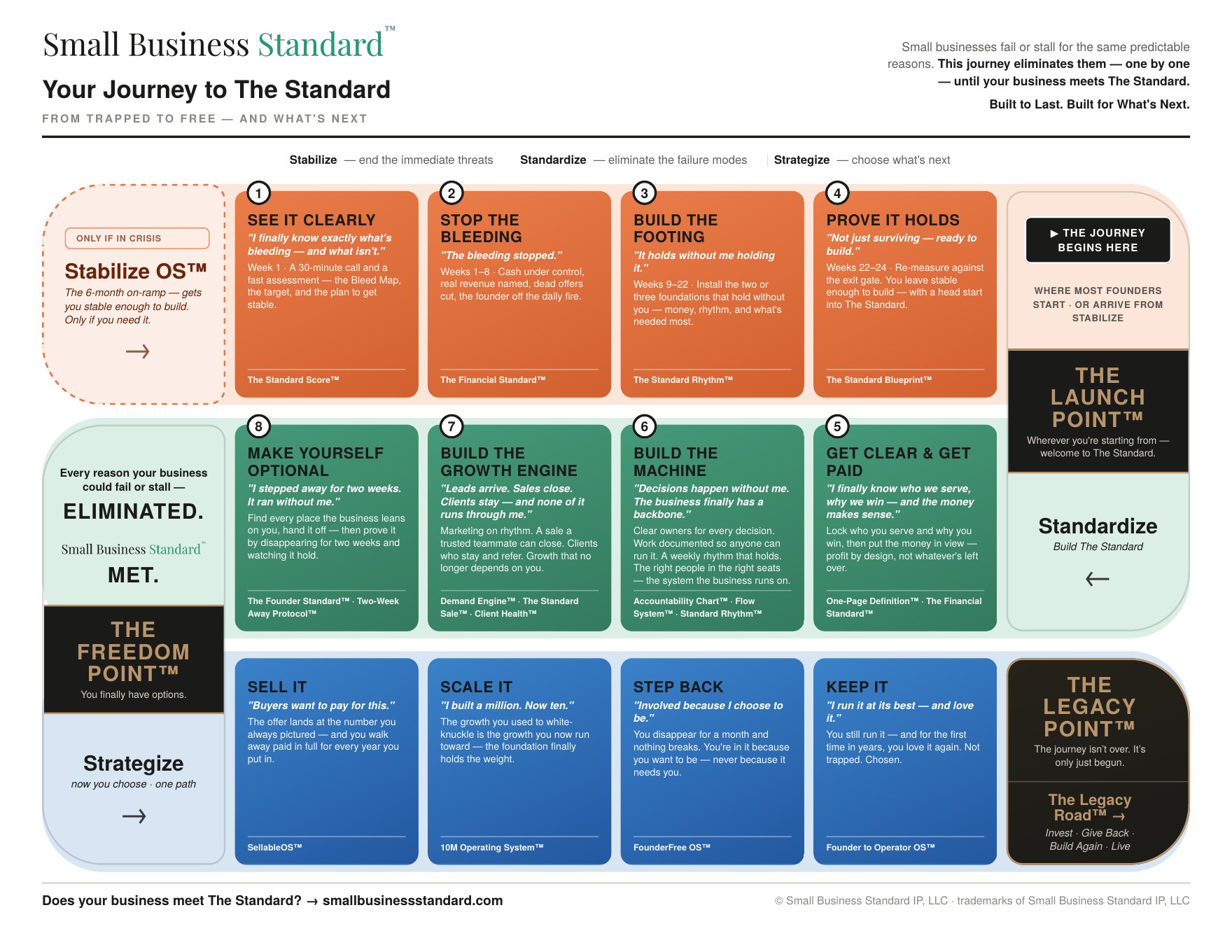
Buyers and sellers measure a business against the gates from the other side. Founders build toward them: from crisis if the ground is moving, then Standardize, then a destination they choose. The stops are listed below; every one is a page.

The Standard Journey — for buyers, for sellers, for founders: one standard, twelve gates
The Standard Journey™ — five roads, one standard. Buyers and sellers measure against the twelve gates from the other side; founders build toward them — from crisis if they must, through Standardize, to a destination they choose.
The founder's stops, in order

Start with the first stop: book a free Standard Session — or take the Score to see where you are on the road.

Why nothing has worked yet

They weren’t wrong.
They were incomplete.

The books named this decades ago. Founders can quote them — “I own a job, not a business” has been in circulation since 1986. And the failure rate hasn’t moved.

One fixed the money.
And the work still had no repeatable way of being done.
One fixed execution.
And selling still depended entirely on the founder.
One fixed the message.
And nothing was written down behind it.
One taught you to systemize.
And then handed you a diagnosis with no standard of care attached.

An open root cause stays open. Recognition was never the missing piece. A standard was — a defined specification, a measurement, a cadence, and something that verifies the work actually got done.

What you end up holding

Not a logo.
A file.

Every gate passes on evidence, and that evidence assembles into a documented record that the business runs on a standard rather than on you. Diligence screens for exactly these things — financials that reconcile, revenue that doesn’t ride one person, operations that survive your absence.

So when someone asks whether this business can run without you, you don’t answer with a promise. You open the file.

See what’s in the file →

Book a free Standard Session Free · 90 minutes · Not ready to talk? Take the free Score first — 15 minutes, no account.

Does your business
meet The Standard?

The free Score tells you which of the eleven domains are open, which root causes are driving them, and what to close first.

Book a free Standard Session Free · 90 minutes · Not ready to talk? Take the free Score first — 15 minutes, no account.

Fair questions.

How is this different from EOS, Scaling Up, or E-Myth?
Those are good systems, and if one is working for you, keep it. They help you run the business better — alignment, meetings, execution, growth. The Standard answers a different question: what does a built business look like, and can you prove yours is one? Eleven domains, twelve elements, each with a gate you either pass or you don’t. The outcome isn’t a better-run business — it’s a business that can run without you, documented well enough that a lender, a buyer, or your own two-week absence can rely on it. Many owners run The Standard alongside their current system; the gates don’t care which meeting rhythm you use, only whether the failure modes are gone.
What does “meeting The Standard” actually look like?
A file, not a feeling. The documented record of every gate your business passed — the systems installed, the evidence behind each one — in a form a lender, a broker, or a buyer can actually read. See the evidence page for what that file contains.
What if my business is unique?
The gates are the same for a two-person shop and a forty-person company — the bar doesn’t move, only the path to it does. The Score calibrates to your business type (product, regulated, multi-owner), so a supply-chain gap or a licensing requirement counts for you even though it doesn’t exist for a consultancy. Unique business, same standard, your path.