At the end of this, you don’t get a badge that asks people to trust us. You get the documented record of a business that runs on a standard instead of on you — and you can hand it to anyone.
Evidence isn’t something you assemble at the end because someone asked. It’s the by-product of running the business properly for thirteen weeks — if the running got written down.
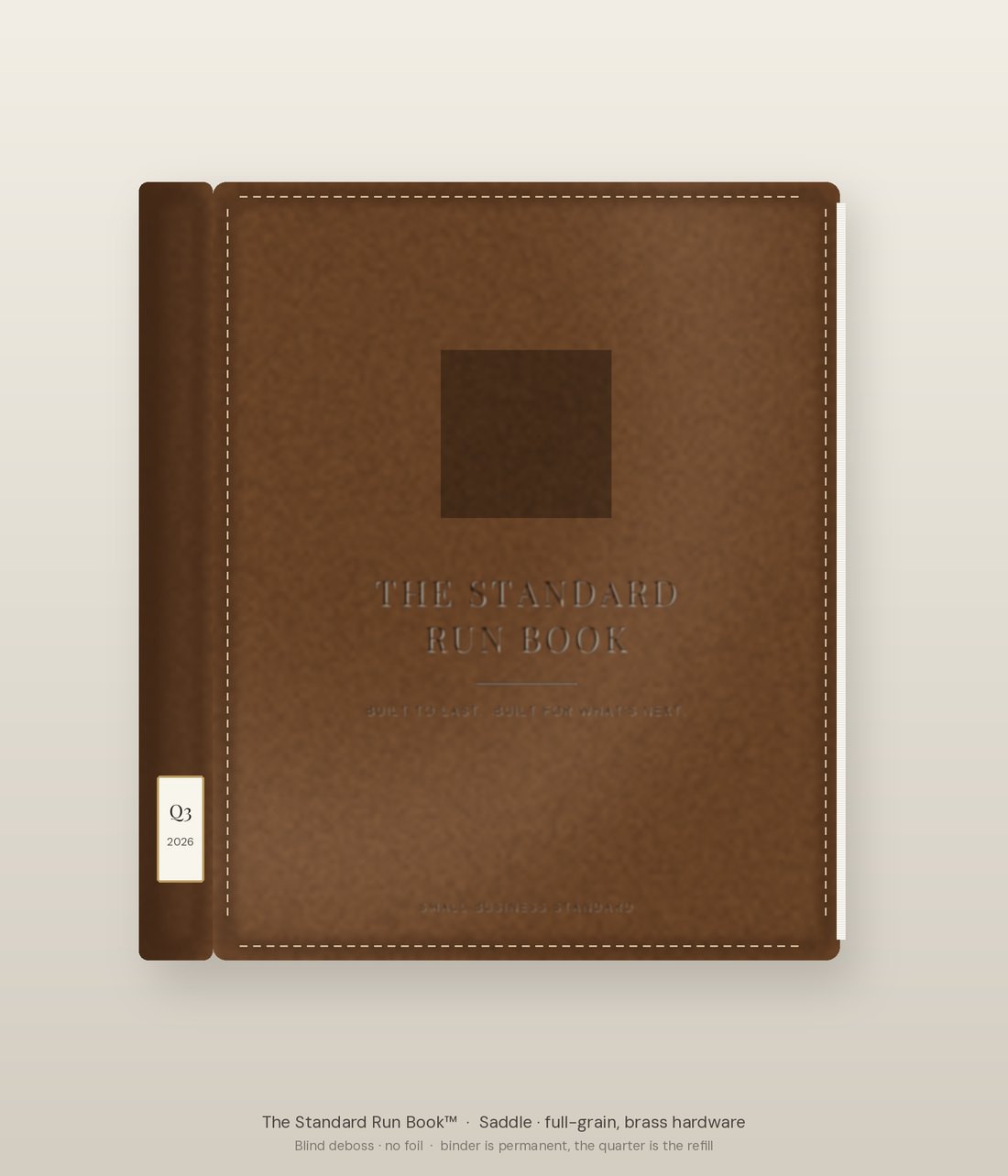
The Run Book is the physical operating book for one quarter. Week packets, the two governing standards, the running ledgers, and the twelve-gate self-assessment. You write in it. When it’s full, you’ve run The Standard for a quarter — and you can prove it.
Then you order the next one and keep the streak. The binder is permanent; the quarter is the refill. The finished ones go on a shelf, which is the only kind of track record that can’t be fabricated after the fact.
A business running on The Standard operates on a defined rhythm across five time horizons — from the day in front of you to the year you’re building toward. Each one sets the frame for the one below it. Each one reports back up.
Every one of those rhythms reads from and writes to the same book. That’s what makes the evidence a by-product of operating rather than a project you take on at the end.
The cadence itself — who attends, how long, what each one produces, and the instruments they run on — comes with the installation. Publishing the specification without the sequence and the accountability is how frameworks get self-installed badly and then blamed.
Every Essential Element passes on evidence, never on effort. That evidence doesn’t evaporate once the gate is passed — it accumulates into a single documented record of how the business actually operates.
Which is worth exactly as much as the reader’s opinion of whoever issued it. And they’ve never heard of us.
Signed closes, a scorecard streak, a filled quarter grid. Operating proof that is very hard to fake and needs no introduction.
Diligence screens for exactly these things — financials that reconcile, revenue that doesn’t ride one person, operations that survive your absence. So when a lender, a broker, a buyer, or a successor asks whether this business can run without you, you don’t answer with a promise. You open the file.
The Score shows which domains you’d be able to evidence today and which you couldn’t. Fifteen minutes, free.