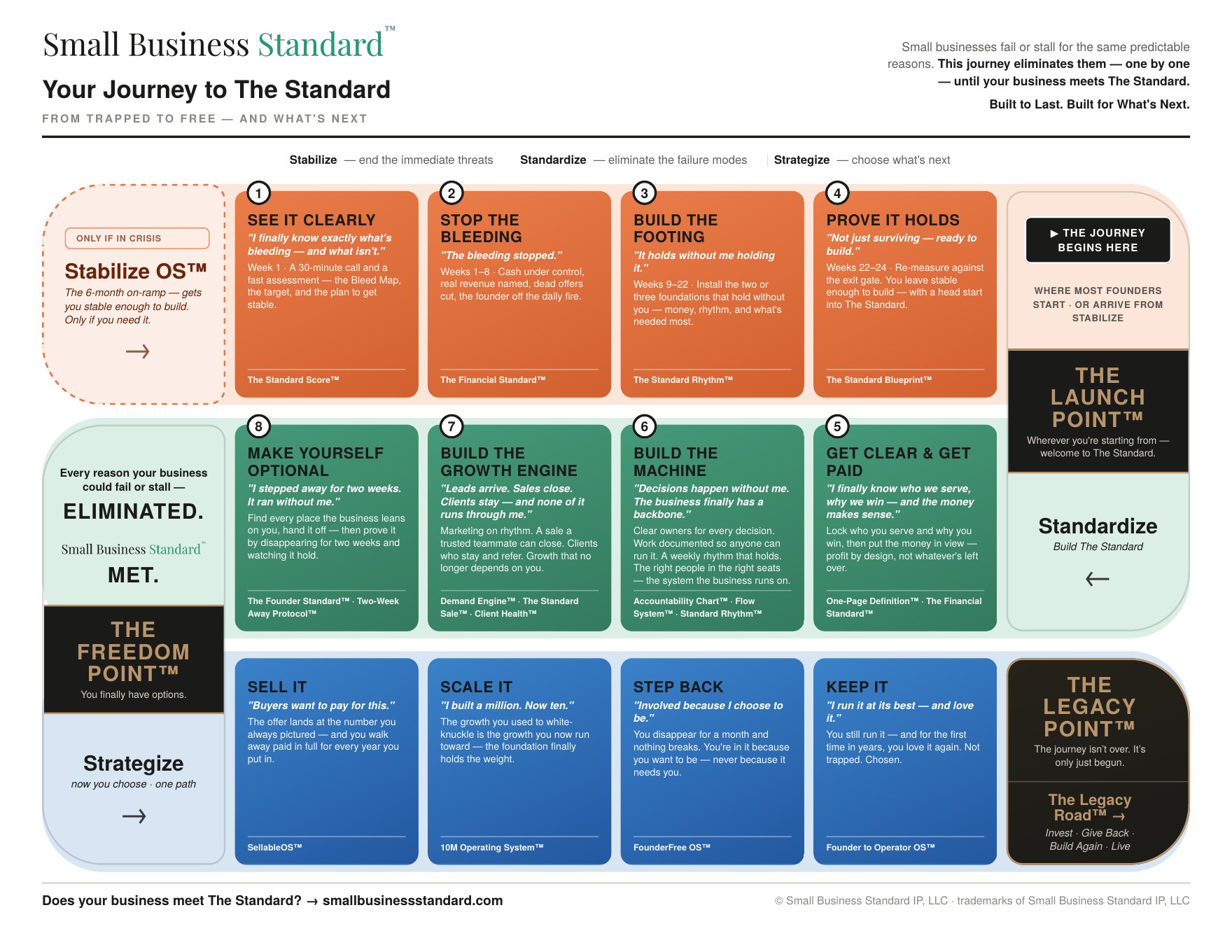
Nothing you tried was wrong — just incomplete. Every framework was built to fix one part of a business. None was built to define the whole thing.
Nothing written down. No money floor. Selling depends on you. No repeatable way. The diagnosis — what explains the pattern.
Where the four actually show up in a business. The levers — because domains are what you can work on.
What closes them. Each one installs a defined mechanism and passes on evidence.
The Standard — the book that lays out the whole architecture, cause by cause — releases in 2026.
Founder dependency isn’t a fifth root cause — it’s what the other four add up to. But it’s the one domain where the instrument has to point at a person rather than a process, because a founder can’t reduce the business’s dependence on him while his own operating system is the thing holding it up.
That layer has its own standard. The Personal Operating Standard™ is our sister standard — same discipline, same insistence on a defined bar, applied to how a person runs their week instead of how a business runs its quarter. Inside an engagement it’s the instrument beneath Domain 06. See the Personal Operating Standard →
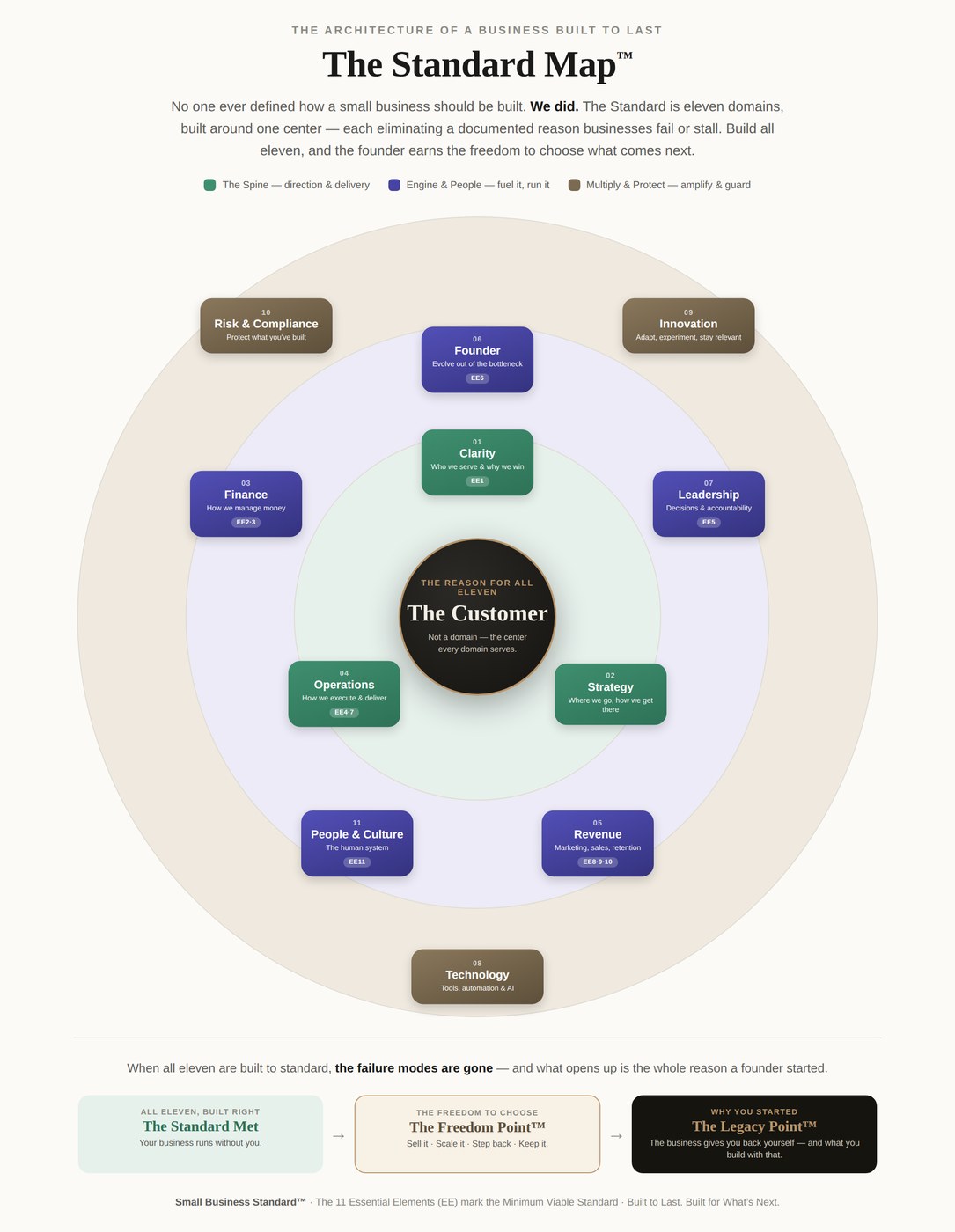
A goal is something you work toward. A gate is something you pass or you don’t. Each Essential Element has a defined installation, a required result, and a gate that checks whether the result actually exists — not whether the work felt hard.
There is no eighty percent. There is no “we’re working on that one.” The gate is the same for a two-person shop and a forty-person company — the bar doesn’t move, only the path to it does. That’s the difference between a standard and a framework.
It’s also why the engagement can’t be sold by the month. It ends at the gate, not the calendar.
You can’t build on ground that’s moving, and you can’t choose a destination from a business that can’t run without you. The sequence isn’t a preference. It’s the order the businesses that broke through actually moved in — floor first, then documentation, then delegation, then the founder off the sale.
The books named this decades ago. Founders can quote them — “I own a job, not a business” has been in circulation since 1986. And the failure rate hasn’t moved.
An open root cause stays open. Recognition was never the missing piece. A standard was — a defined specification, a measurement, a cadence, and something that verifies the work actually got done.
Every gate passes on evidence, and that evidence assembles into a documented record that the business runs on a standard rather than on you. Diligence screens for exactly these things — financials that reconcile, revenue that doesn’t ride one person, operations that survive your absence.
So when someone asks whether this business can run without you, you don’t answer with a promise. You open the file.
Fifteen minutes tells you which of the eleven domains are open, which root causes are driving them, and what to close first.