Small Business Standard — The standard a business is measured against when it's built, bought, or sold.

Small Business Standard™

The standard a business is measured against when it's built, bought, or sold.

Twelve published gates. One instrument. Whether you built the business, you're buying one, or you're selling yours, this is what it gets measured against.

Book a free Standard SessionSee the twelve gatesNinety minutes with the founder and the leadership team. No pitch in it.
The Standard Report™
Example Co. · commissioned by the buyer · Standard scope
Evidence window 08/04–08/22/2026
Verified against the published gates · page 2 of 14
Verdict · twelve elements
EEElementEvidence citedDatedState
EE1ClarityOne-page definition v3; three non-founder interviews08/26MET
EE2Financial VisibilityAccount structure; 60 days of allocations; weekly review log08/26MET
EE3Profit DisciplineProfit target present; margin by offer not calculated08/26NOT MET
EE4Operating CadenceLeadership Weekly, 7 of 8 weeks; all founder-facilitated08/26NOT MET
EE5Role Clarity & AccountabilityChart signed and displayed; five decisions traced08/26MET
EE6Founder Dependency ReductionDependency audit requested; no record exists08/26NOT EVIDENCED
EE7Core Process DocumentationThree processes; transfer test stalled at step 408/26NOT MET
EE8Marketing SystemLead log 12 mo; publishing record; two referral partners08/26MET
EE9Sales SystemPipeline export; 0 of 14 closes by a non-founder08/26NOT MET
EE10Customer Retention SystemConcentration 31% top client; churn tracked08/26MET
EE11People & Culture FoundationValues stated; hiring process undocumented08/26NOT EVIDENCED
EE12Delivery & QualityPromised outcome per offer; checklists in use; defect log08/26MET
Owner-dependency exposure
4 of 5 decisions were the founder’s3 of 3 core processes founder-only0 of 14 closes by a non-founderNever tested a two-week absence
Remediation map
EE4Non-founder facilitator; eight weeksMTeam
EE6Dependency audit; one delegation, 60 daysLTeam · SBS
EE7Document the approval; re-run the testSTeam
EE9Sales process; one close by a teammateMTeam · any operator
Exposure total: $32,000–$71,000 · 5–7 months · EE6 depends on EE4Not a certification, valuation or QoE · reliance as stated on page one · Architect’s signature
Click to enlarge

The verdict page, page two of a fourteen-page Report: twelve lines, three states, no score and no average. An example of the format — click to enlarge.
Which one is you?

For buyers
I'm buying a business

You can't see what you're buying.

The numbers checked out. Nobody has checked whether any of it survives the day the owner hands you the keys. The Standard Report answers that in writing — fifteen working days, before you close.

For buyers
For sellers
I'm selling mine now

You can't prove it runs without you.

Most owners find out whether their business is transferable after they go to market. The ones that sell get discounted for one reason: the buyer is buying a job. Get verified before you list — proof, not a promise.

For sellers
For founders
I built it, and I'm staying — for now

You can't leave it.

Revenue's fine. You aren't. The same twelve gates a buyer would measure you against are the ones that let you step back, scale, or sell on your terms. Build a business you can love or leave.

For founders

What you get, whichever door you came through.

An answer in writing

Twelve elements, each MET, NOT MET or NOT EVIDENCED, with the evidence cited and dated. Signed. No score, no average, nothing to interpret.

The price of closing the gap

Every open gate costed: what it takes, how long, and who can do it — your team, us, or any competent operator.

A decision you can defend

To a lender, a partner, a board, or yourself. Verified against a published standard anyone can read.

PublishedTwelve elements, each with a written gate. Anyone can read them.
SignedBy the Architect who did the work, with a blind second pass.
IndependentFixed fee, paid at engagement, never contingent on the findings.
Fifteen working daysFrom the day the data room opens. The clock is in the contract.

Financial performance is one risk. Whether the business transfers is another — and it never had a published standard.

Larger acquisitions get a Quality of Earnings report; from October 1, 2026, the SBA requires one on certain 7(a) acquisitions at $3 million and up. It says whether the earnings are real. It doesn't say whether they survive the owner leaving — a distinction the SBA's own rule draws when it exempts owner buyouts because the existing owner keeps the operational knowledge. That second risk has always been judged by feel. The Standard makes it a measurement: twelve elements, each with a written gate, each met or not met, each with the price of closing it.

  1. A one-page definition of the business that three people who aren’t the founder can pass.EE1Clarity
  2. Money in the right accounts, allocations executed for sixty days, reviewed weekly.EE2Financial Visibility
  3. A profit target, margin known by offer, and an expansion decision made against it.EE3Profit Discipline
  4. A leadership meeting that ran eight consecutive weeks without the founder in the chair.EE4Operating Cadence
  5. An accountability chart, signed and displayed, with decisions traceable to a name.EE5Role Clarity & Accountability
  6. A dependency audit, a delegation held sixty days, an absence tested.EE6Founder Dependency Reduction
  7. Core processes documented well enough that a stranger can run one cold.EE7Core Process Documentation
  8. Leads generated by a system with a record, not by the founder’s calendar.EE8Marketing System
  9. A sales process someone other than the founder has closed with.EE9Sales System
  10. Concentration known, churn tracked, relationships owned beyond the founder.EE10Customer Retention System
  11. Stated values, a hiring process that has been followed, a candidate declined.EE11People & Culture Foundation
  12. A promised outcome for every offer, checklists in use, defects logged.EE12Delivery & Quality
Read the twelve gatesPublished. Free to read. Each has a written pass/fail gate. Only we verify against them.

One instrument, whoever is holding it.

A buyer commissions it

The Standard Report, between letter of intent and close. Paid from the deal, not the founder's pocket. Stands alone — worth its fee if you never call us again.

An owner commissions it

Standard Verified, before listing or after a sale fell through. The same twelve lines, signed, shareable with buyers and lenders under NDA.

A founder builds toward it

The Standard Session is free. The Blueprint Day names what you fail and starts closing it. Build ends at the gate, not the calendar.

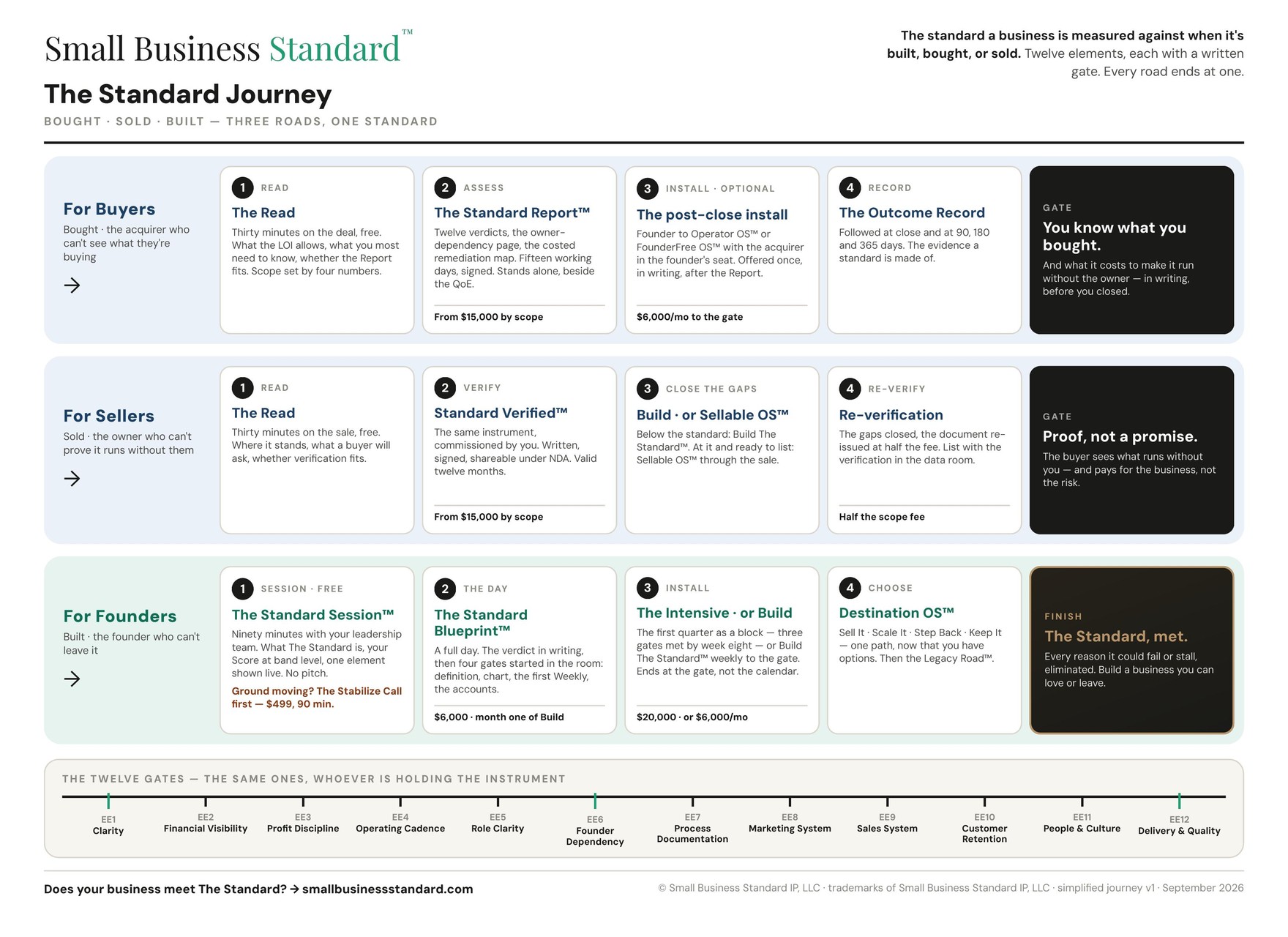
The Standard Journey — three roads, one standard, twelve gates
Three roads, one standard. Every road ends at a gate. See the full journey.

What it costs to keep guessing.

The buyerFinds out in month three, with the debt. The seller is gone and the knowledge went with them.
The sellerTakes the discount, or takes the business off the market and tells people it wasn't the right time.
The founderWorks another year at the centre of it, and the business is worth less at the end of it than it looks.

Where to start.

Three doors, three first steps. None of them costs anything.

For buyers
The Read
Free · 30 minutes

Thirty minutes on the deal. Then the Standard Report from $15,000, by scope.

For buyers
For founders
The Standard Session
Free · 90 minutes

Ninety minutes with your leadership team. Then the Blueprint Day at $6,000 if you want it.

Book a Session
For sellers
The Read
Free · 30 minutes

Thirty minutes on the sale. Then Standard Verified from $15,000, by scope.

For sellers

Someone is going to measure your business — a buyer, a lender, a broker, or the week you finally try to take two off. The only question is whether you know the answer first.

Nobody meets The Standard yet. Including us. Here is our own verdict, gate by gate.